The Biggest Changes to Offense in College Football 27 (and How to Use Them)
Heads up before you load into your first game: the passing game in College Football 27 is not the one you mastered last year. There is a new mechanic that decides whether your wide-open post is six points or a drop, and it is turned on out of the box.
Early hands-on tape is already out ahead of the July 9 release, so we have been through the new offense top to bottom. Offense is one slice of a big update, and the full picture lives in our What's New in CFB 27 Dynasty rundown. One note before we start. This is all from a pre-launch build, so a button or a number here and there can still move before launch.
Here is the offense stuff worth knowing, ranked by how much it changes your next game:
- Timing based catching (touches every pass play, all year)
- Formation shifts (disguise the look every snap)
- The QB sneak meter (short yardage is a skill now)
- Chip and release (beat the blitz without losing a route)
- Custom adjustments (your answers, pre-loaded)
- Play call substitutions (get the right guys on the field)
- The speed cheese is dead
Now the how.
1. Timing based catching is the whole ballgame
This is the big one, maybe the craziest change to offense we have gotten in years. On any throw five yards or longer, you hold the catch type you want and a little meter fills up next to your receiver. Release it in the green and you get a perfect catch. Let go early and it goes yellow. Hold it too long and it goes red.
Here is what those colors actually mean. Green is the perfect catch, but only if your guy can physically get to the ball. Throw it into a bracket or behind him and a green does nothing, because he never had a play on it. Yellow drops you back into the old system, the ratings-and-situation dice roll you have lived with for years. Red is dead. Held too long, ball hits him in the chest, incomplete.
And green only pays off when the throw is into a real window, so read the coverage before you cut it loose. If single-high shells still give you fits, start with how to beat Cover 3.
The move is to release the catch button just before the ball reaches his hands, not as it arrives. That early release is the green window.
A couple things for your settings. It is on by default at five yards and up, you can push that threshold in five-yard steps, and you can shut it off completely. The early read is to set it to ten, because under ten the ball gets there so fast you can barely react. Over ten you actually have time to feel the meter. Try ten and adjust from there.
The part people will sleep on: this is a skill you can get in about five minutes. It is a bonus layer on top of normal catching, so even when you whiff the timing you fall back to the old dice roll. Go into practice, throw ten go balls and ten posts, and get the feel before you take it online. The guys who put in that five minutes are picking up free third-down completions while everyone else drops them.
2. Formation shifts let you lie to the defense
Formation shifts are back, and they are exactly what they sound like. You line up in one formation and snap from a different one, after the defense has already shown you its hand.
At the play call screen: pick your play, toggle the formation shift with the right stick, then pick any formation that uses the same personnel. Break the huddle and your guys motion into the new look before the snap. Come out in a bunch and shift to five wide, and the slant opens up into space the defense never adjusted to.
The reason this is strong is leverage. A defense that checks its coverage and its front to your bunch look is now defending five wide with the wrong call. You get the matchup you want while they scramble to fix it with two seconds on the play clock.
Do not overthink it early. Pick one base play you trust, find a shift you like out of it, and run it until you can do it without looking. Once it clicks you will be shifting almost every snap, because it is that fun and that hard to defend.
3. Short yardage is a skill now
The QB sneak got a meter. Call a sneak on fourth and inches and a bar pops over your quarterback's head. Snap the ball when it sits in the green in the middle. Nail it and you fall forward for the yard. Miss it and you can get stuffed for nothing.
What sets that green window is the trench math. Your center, both guards, and your quarterback get measured against the nose tackle and whatever is over the interior. Weight, strength, run blocking, and block shed all feed into it. Lining up in an open A gap helps too.
It is harder than it looks. You will miss a few while you learn, and that is the point. EA wanted short yardage to stop feeling automatic, so the sneak is a real decision now.
One thing to know: the actual Tush Push, the rugby push from behind, is in Madden 27 only. In College you get the sneak meter. If you lived on QB sneaks last year, go rep the timing in practice before you trust it on fourth down in a one-score game.
4. Chip and release saves your blitz pickup
For the first time you can put your running back or tight end on a chip and release. He hesitates, chips the blitzer to slow him down, then runs his route.
This is a step past the old check and release, where the guy either stayed in to block or ran his route. Now he does both. He buys you the half second you need against pressure and still gets out into the pattern.
To set it: hot route your back or tight end onto the route you want, then tap X (Square on PlayStation) to put him on the chip. Put a tight end on a deep crosser with a chip and he hesitates to help the protection before releasing into open grass.
Use this when you know a buddy loves to bring the house. Put your back on a chip and a wheel, and you have answered the blitz and turned a checkdown into a big play at the same time.
5. Custom adjustments put your answers two clicks away
EA built custom adjustments into every play in the game. Tap LB (L1 on PlayStation) on offense and you get pre-made macros right there, things like sending everybody on a double move or flipping the whole concept to four verticals.
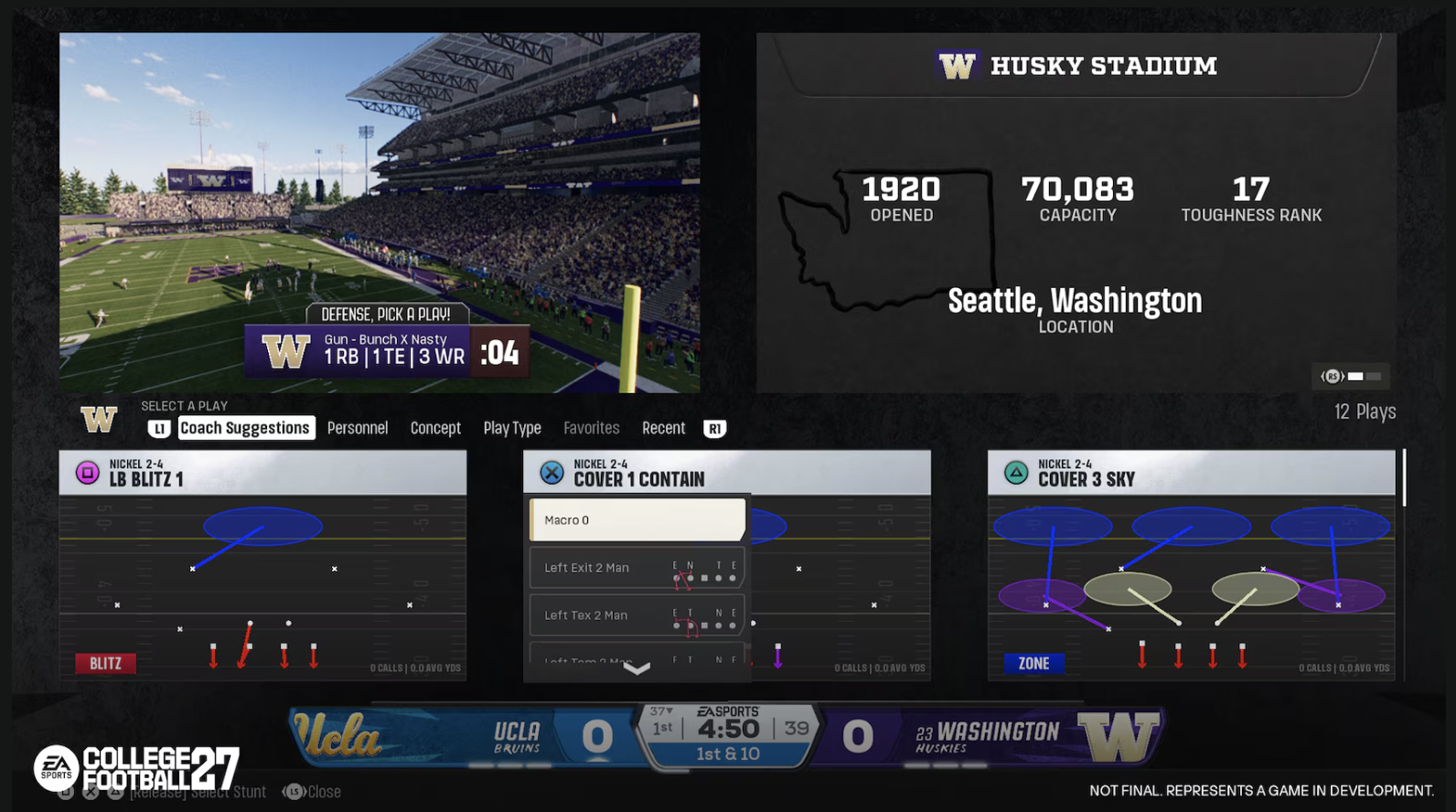
Every play ships with built-in offense macros like all verticals or double moves, ready to call in two clicks. Image: EA Sports
Better than that, you can build and save your own. Up to ten preset setups you design once and then call from the play screen, with your protection and routes already dialed. Set your standard coaching adjustments once in the main menu, under Settings then Game Settings then Coach Adjustments, and they carry into every game. Set it and forget it.
There is one specific adjustment worth turning on right now if you play online. It is the on-target user defender setting. Flip it on and your offensive line ignores the defender your opponent is controlling. So when he stands a guy on the line of scrimmage to fake pressure and bait your protection, your line does not bite. You pick up the actual rush and dot it.
One catch worth knowing: you can pick a custom adjustment at the play call screen, but you cannot change it once you are at the line. Set your look before you break the huddle.
6. Play call substitutions get your studs on the field
You can now make personnel changes straight from the play call screen, before you break the huddle.
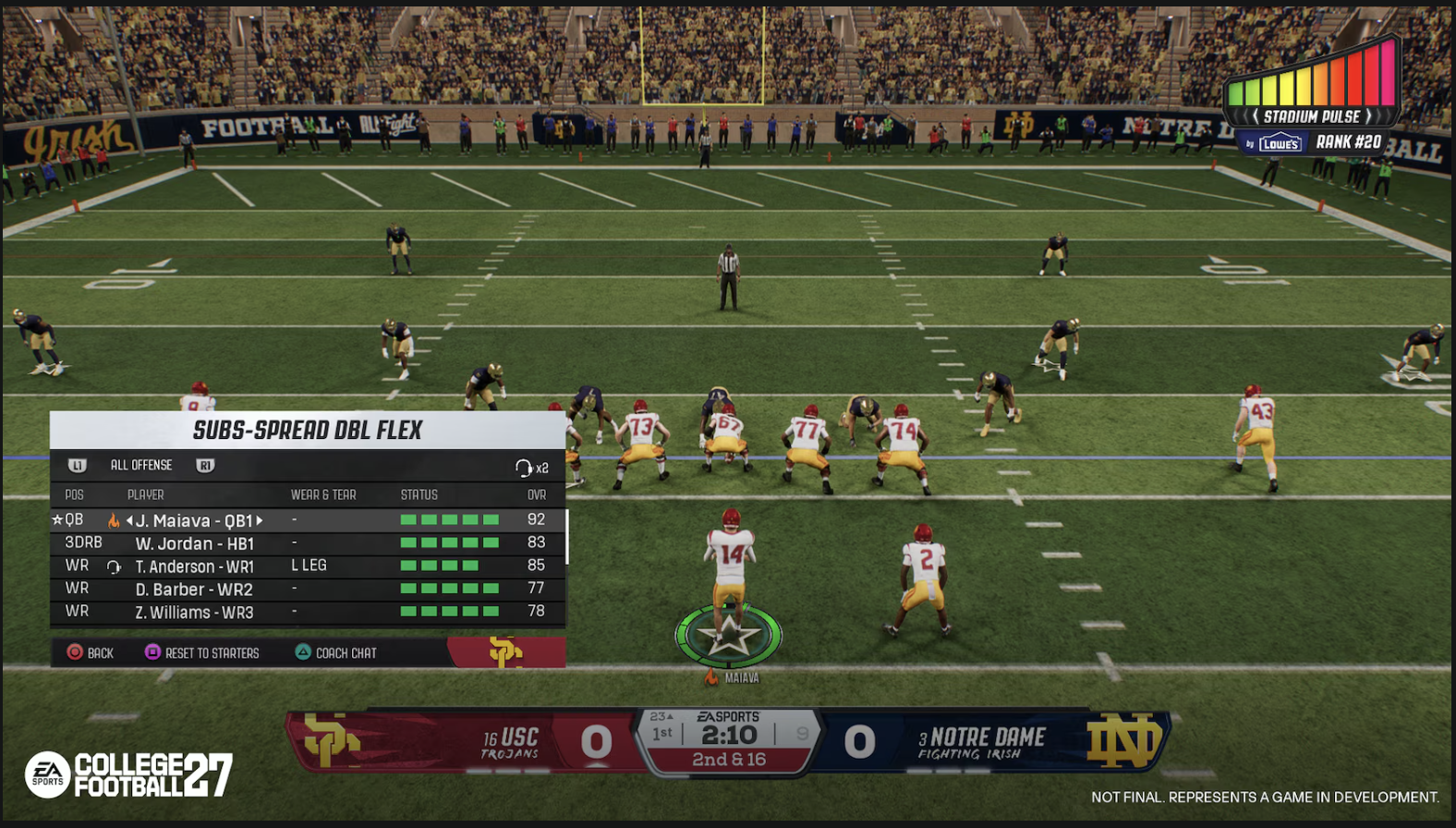
Swap personnel straight from the play call screen to get the matchup you want before the snap. Image: EA Sports
This sounds small. It is not, if you care about matchups. Want your burner in the slot on third and seven, or your blocking tight end in on fourth and one? Make the swap as you call the play instead of digging through a sub menu and burning a timeout.
The move is to set your obvious passing-down and short-yardage packages early so they are one click away when you need them. Speed is still king in this game, so get your fastest guy on the field in space and let him work.
7. The speed cheese is dead, and it needed to die
The old speed boost is gone. You know the one, where you abused turbo to hard-cut and wiggle up the field at a speed no human moves at, breaking every pursuit angle in the game. That exploit is out.
The sprint button is still there and still matters. What is gone is the unrealistic version that let a 78 speed back juke the whole defense into the dirt.
This is good for anyone who actually likes ball. Speed is king, it always has been, and now it is real speed off the roster. Recruit the burner and build the burner, and he will still take the top off a defense. The guy mashing turbo and praying does not get the bailout anymore.
A few smaller ones worth knowing
- ID the mic actually changes your run blocking now. It was hit or miss in past years. This year it is by design, so pointing out the mike before the snap moves your blockers the way you would expect.
- The right stick can blow up blocks as a lead blocker. Pulling a guard or leading with a back, you can flick the right stick to truck the defender instead of just running into him.
- Saved coaching adjustments carry over. Same idea as the custom adjustments above. Set your option key and your protection slides once in the menu and never touch them again.
None of these are headliners, but the run-game ones stack up over a season.
What to do tonight
Load up practice and throw twenty balls with timing based catching on. That is the one change that touches every drive, and the feel takes about five minutes to get. Set it to ten yards, get the green window down, then go run your stuff.
Everything else you can pick up on the fly. The catch timing is the one that costs you games in week one if you skip it.