How to Recruit in College Football 27 (NIL Is King, and the Rug Pull Is Dead)
Recruiting in College Football 27 comes down to one lever, and it is not hours. It is NIL.
For years the move was to paper your whole board with offers, pour hours into everybody, then pull those hours back at the last second once your rivals stopped chasing. That entire playbook is dead this year. NIL runs the trail now, every offer is a real commitment you cannot walk back, and the coach who spends with a plan beats the coach who spends the most.
Here is the method up top. In Week 0 you scout, you do not offer. Then you clear the expected number on the short list of kids who actually fit your scheme, let your hours ride on top, and never put down a dollar you are not prepared to pay again every year he is on your roster. Everything below is why each of those rules holds.
This is the how-to. The system underneath it is Two-Sided NIL, and the trail it runs on is how recruiting works in CFB 27.
NIL is king
Start here, because it reframes everything else. NIL is not a tiebreaker you reach for after hours. It is the switch that decides whether your hours count at all.
Creators with the game early ran the test cleanly. Put your NIL below a kid's expected number, then load him with weekly hours anyway, and you gain almost nothing. The hours just burn. Flip it around, put a strong number down with no hours at all, and you can still hang stride for stride with a CPU school pouring everything into him. The money is doing the work. Hours are the multiplier sitting on top, and a multiplier on zero is zero.
So the read on every offer is the same. Meet his expected number and your hours land at full value with no penalty. Go under it and you slide into the red, your interest stalls, and those hours stop mattering. Clear it and you stack a weekly bonus on top of the hours, and that bonus climbs the higher you go, all the way to a full green at double his ask, which is the ceiling. No offer is generous enough to break that cap, so twice the number is the most you ever need.
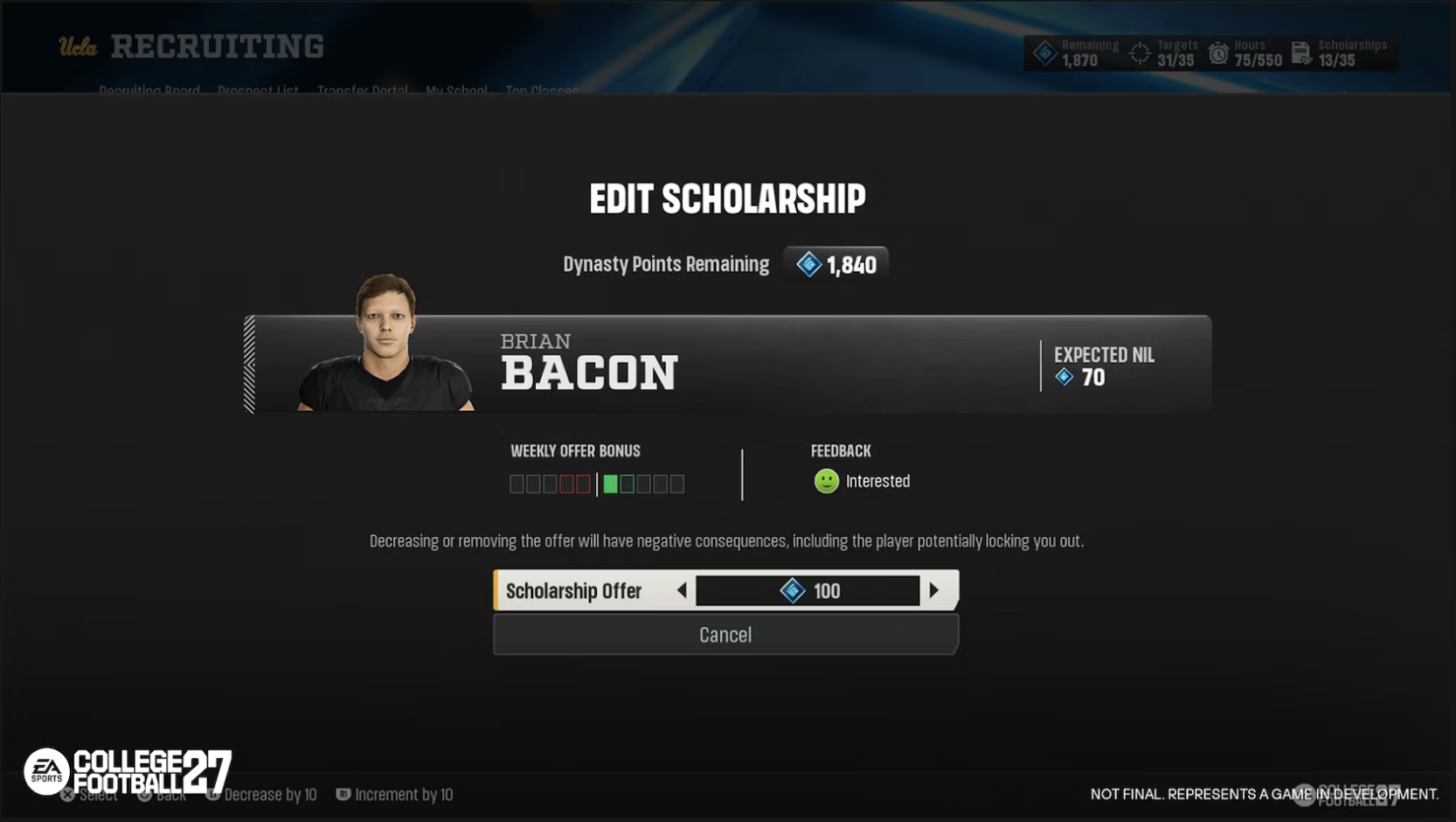 Clear the expected number and the kid reads Interested and your weekly hours start paying off. Sit under it and the same screen flips the other way. Image: EA Sports.
One wrinkle worth banking early: NIL hits hardest in the opening weeks and loses a little steam as a kid narrows his list. By the time he is down to his top five you are into hard-sell territory, so the move is to grab the early lead with money and close it out with a hard sell and your hours. It tilts even further your way before you have stacked elite recruiter and your support staff packages, when NIL decides more of the board than anything else.
The practical version: decide who is worth real money before you spend a single hour. Hours follow the money in this game, not the other way around.
The rug pull is dead
This is the big one. The rug pull is the move everyone hoped to get away with under the new NIL: commit a kid on a big number to grab the lead, then quietly trim the money back toward his real ask once your rivals stop chasing. The early-access testing says it does not work.
Here is the mechanic. The second you set an offer and advance the week, that number becomes the kid's new baseline. Everything above it still reads as a bonus. Everything below it now reads as a cut. So if you offer 300 this week and try to trim to 295 next week, that five-point haircut does not land like a sliver off a big number. It lands like you lowballed him, because his floor is 300 now. He drops into the red and you have gutted your own recruitment over nothing.
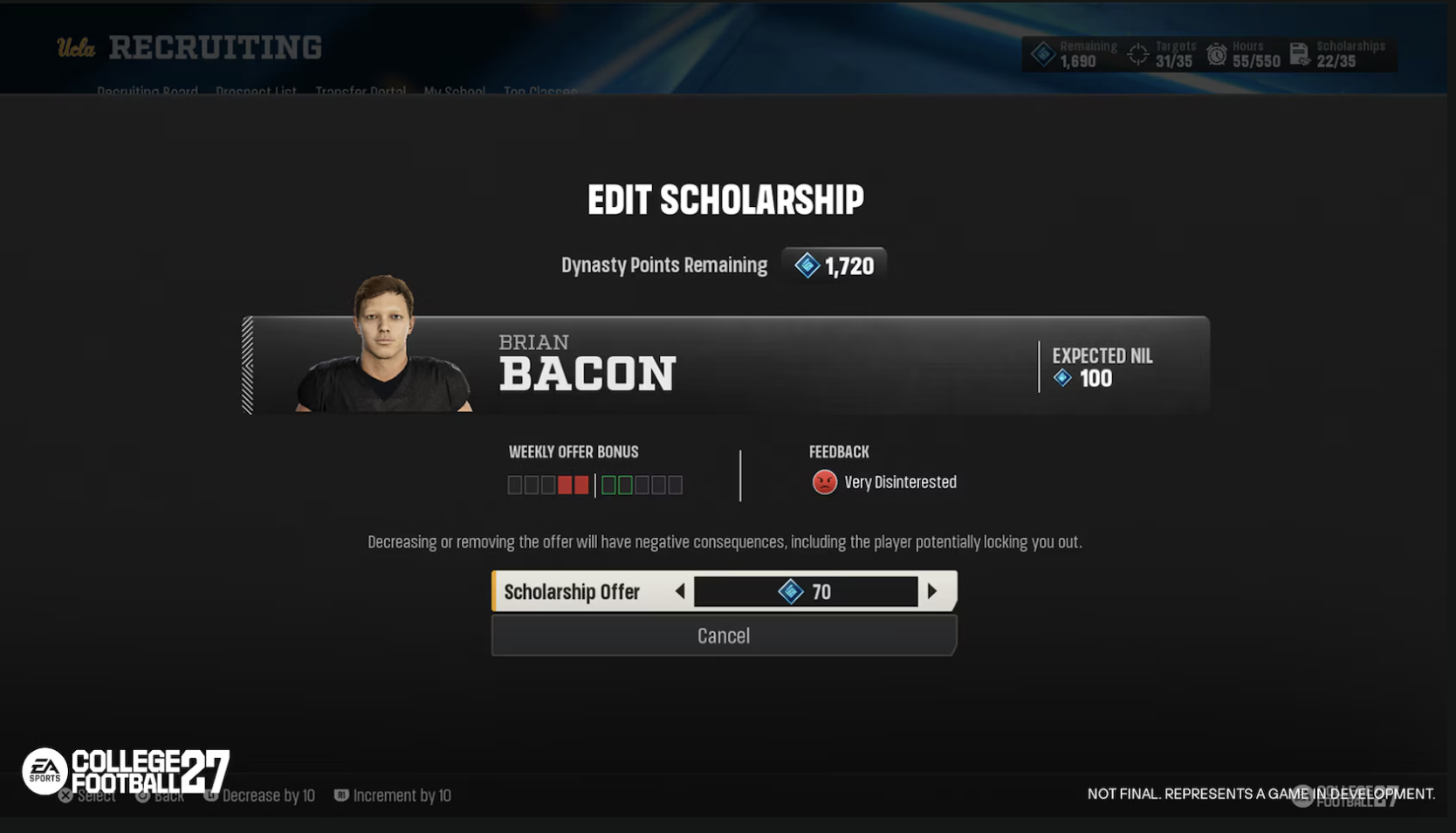 Drop below the number he is already counting on and the screen turns to Very Disinterested. That is the rug pull dying in real time. Image: EA Sports.
It gets worse if you panic and slam the number all the way back to what he originally wanted. Now you do not just lose the bonus, you can end the recruitment on the spot, hours and all. There is a narrow safe band, you can shave a little as long as you stay near the top of the green and never dip to his new baseline, but the math almost never justifies it. Claw back thirty points and you are usually still paying most of the bag while handing back the easy win, so you are better off leaving the number alone. Treat every offer you set as final: if you would not happily pay it next year and the year after, do not put it down this week.
There is one rug pull that does still work, and it is hours, not money. Once your NIL has a kid locked, you can pull your weekly hours off him and spend them where they are needed, like setting up visits, then circle back later. The money holds your lead while the hours go to work elsewhere, a luxury you never had when hours were the only currency.
That is the floor trap from the NIL breakdown showing up live on the trail. Win a bidding war you did not need to win, and you are stuck paying that number for four years.
Recruit to your scheme, not your whole board
Because every offer is a real, lasting cost now, you cannot hoard talent the way you used to. Sign a stable of five-stars and their numbers compound every season until your budget cannot breathe. The game is quietly steering you toward fit over a trophy board.
So recruit your scheme. Pay up for the few spots your offense and defense actually live on, and stop bidding on the luxury guys who will never see your field. A man-coverage team pays for man corners and lets the zone guys walk. The road grader you will never run behind is somebody else's problem.
Then go hunting for value, because this is where a smaller program claws its points back. A recruit's national rating does not decide his dev trait or his skill caps. The kid ranked 1,500th can out-develop the one ranked 400th, and his expected NIL is a fraction of the price. Creators rebuilding from the bottom are leaning on this entirely: scout deep, find the low-rated three-stars sitting at near-zero NIL, sign a pile of them for five or ten points apiece, and bank everything else for the portal where the real bidding happens.
One trap to dodge while you do it. Avoid kids whose dealbreaker is Playing Style. They demand a raise the moment they are not starting, and you either pay it or lose them. If you are taking one anyway, treat him as a one-year rental, ideally a junior, and do not build around a number you will resent in twelve months.
The prestige tax is real
None of this is priced evenly, and the math runs against you if you are climbing. The same recruit costs a low-prestige school more than a blue blood, not less. Alabama signs a kid who already wants to be there. A three-win program has to wave a bigger bag just to make his list.
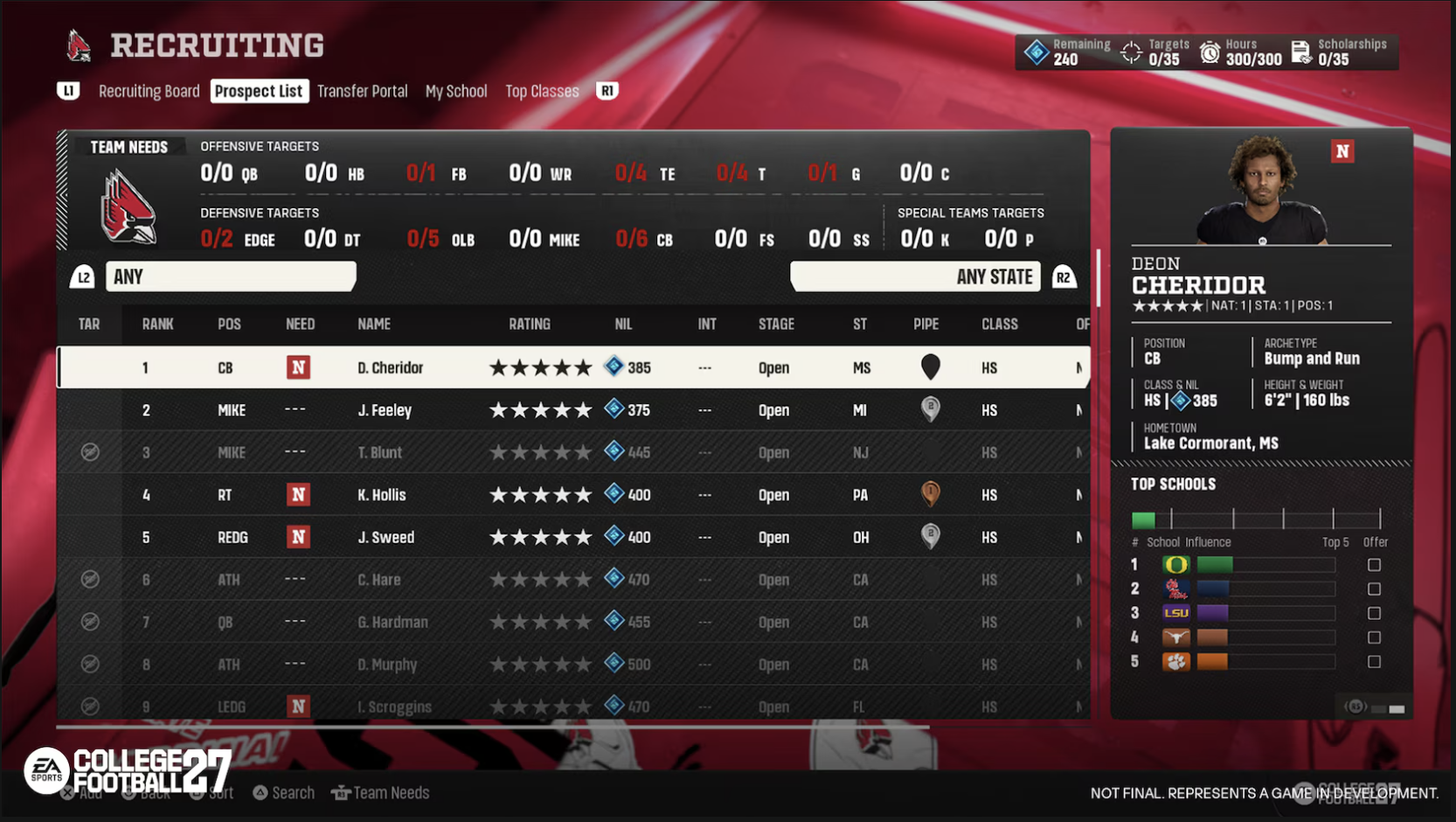 At a blue blood the expected numbers sit low. Run the same board at a bottom-tier school and every figure climbs, for the exact same players. Image: EA Sports.
That is the prestige tax we broke down in Two-Sided NIL, and it is exactly why the gem-hunting method matters more for you than it does for Georgia. You are not going to win straight bidding wars against the big dogs, so do not try. Win the kids they are not bidding on, clear those numbers cleanly, and let your scouting be the edge your budget is not.
Keeping them is the same fight
Signing a class is only half the bill. At the end of every season the game hands you a retention pass, and every rule you just learned comes right back. Each guy carries an expected number that climbs off his overall, his role, his awards, and whatever you have paid him before, and a Risk of Leaving flag tells you who is about to walk.
The trap is the same one in a different coat. The cheap freshman you signed for 20 points wants 120 after a breakout year, and you either pay the raise or lose him. So protect the handful you cannot replace, let your depth leave, and remember that every overpay on the trail is a retention bill waiting two seasons out. The full retention breakdown lives in Two-Sided NIL, and the wallet it all spends from is the Dynasty Blueprint.
A few things sharpen that screen. A full double offer locks a guy in for good, he will not even show up on the leaving list, while anything less is a gamble even when the game reads his odds of staying as high. A bad dealbreaker tilts it harder, since something like no playing time can double what a player wants to stay, which is exactly where the Strategist ability earns its keep now: it trims the number you owe, not just the odds he walks. And price the whole class out before you go all-in, because re-signing every name on the list is how you wake up with a full roster and no points left to recruit next year. The same bidding logic runs your coordinator hires too, which we get into in Coach and Career.
What we are still nailing down
Year one means a few pieces are still getting tested in real games. Two worth watching. Whether the green bonus scales perfectly smoothly point for point or jumps in steps, which decides if 270 is as good as 295 when both show a full green bar. And whether yanking an offer too far trips a hard lockout or just craters interest. Neither changes the method. They only decide how fine you can shave the edges. One bigger unknown sits underneath all of it: most of this comes from solo dynasty, where the CPU barely spends NIL. A human league where everyone is dropping bags will lean harder on hours and hard sells, and EA could still tune the balance before launch.
Where to start tonight
Open your board in Week 0 and scout before you spend a thing. Find the kids your grades and pipelines actually reach, then split them into two piles: the few scheme-fit guys worth clearing the number on, and the cheap gems worth a five-point flier. Offer the real money only where it fits your scheme, and only at a number you will happily pay for four years.
Then leave it alone. The single most expensive mistake in CFB 27 recruiting is winning a bidding war you were already ahead in. Once that number is down, it is down for good.