The Dynasty Blueprint in College Football 27 (What It Is and Where to Spend)
Your new Dynasty does not open with the depth chart. It opens with a budget screen.
College Football 27 hands you one pool of Dynasty Points every year and makes you decide where every point goes. That pool is the Dynasty Blueprint, and it quietly decides more of your season than any play you call. It is the engine running under everything in our What's New rundown, so it earns its own breakdown.
Here is the whole thing in one line. Find the one area your program needs this year, dump your points into it, and quit trying to fund everything at once. The points do not roll over, so a thin budget spread evenly is how you finish second in every race on the schedule.
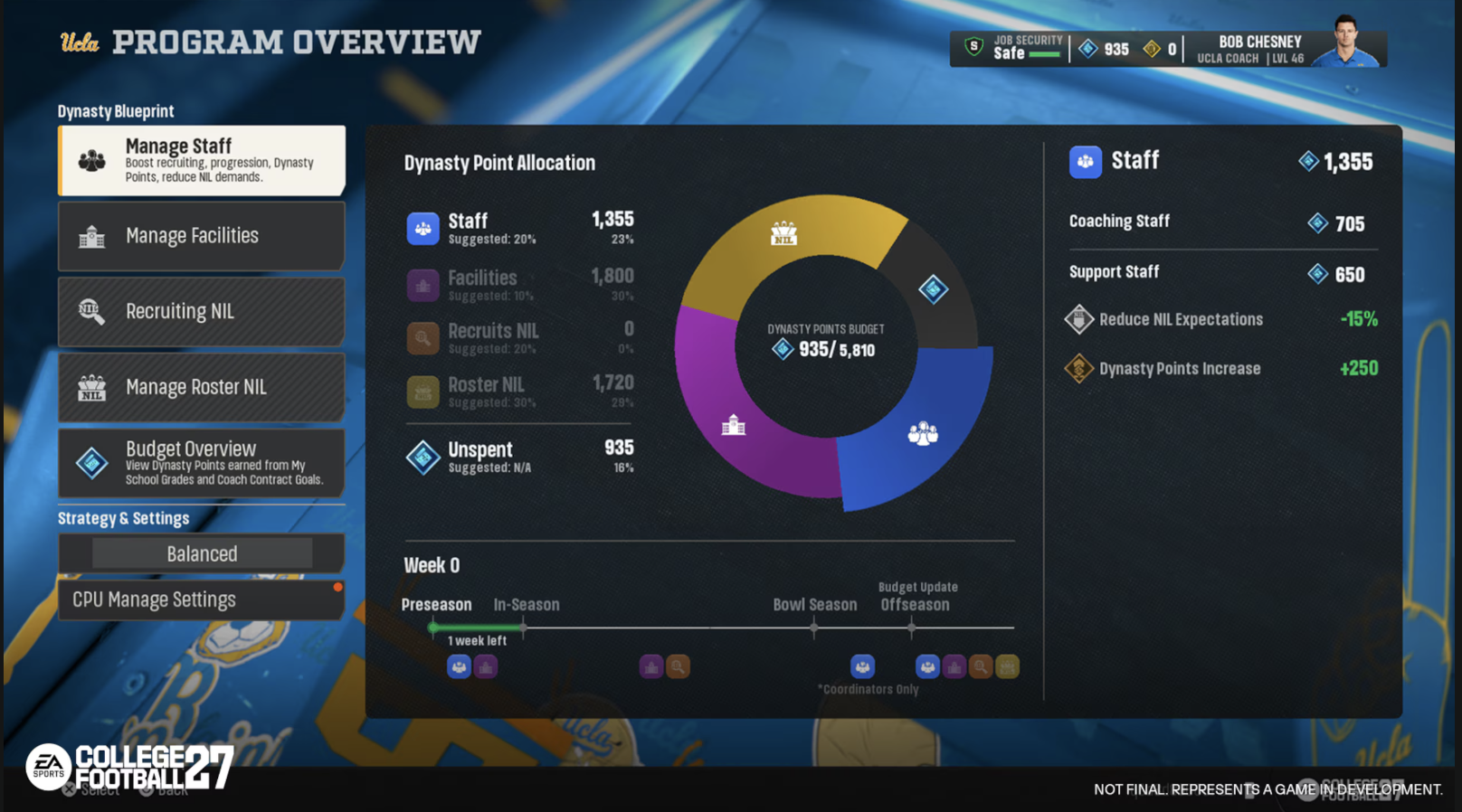 The Dynasty Blueprint screen, where you split one yearly pool of points across staff, facilities, and NIL. Image: EA Sports.
What it is
The Blueprint is the single page that runs your program. Staff, facilities, recruiting NIL, and roster retention all live there, and Dynasty Points are the currency you spend across them.
Your points are a yearly allowance, and the size of it is not equal across schools. It is set by your My School grades like Conference Prestige, Brand Exposure, Stadium Atmosphere, and Program Tradition, then topped up when you win your conference, make the Playoff, take bowl games, and bring home a natty. Alabama wakes up rich. Kent State wakes up broke. Same as real life.
Three buckets pull from that one wallet:
- Staff. Support staff plus your coordinators.
- Facilities. Your Athletic Facilities grade, which drives how fast your roster develops.
- NIL. Recruiting NIL to land players, Roster NIL to keep the ones you have.
Staff. Your support staff slots are tied to Team Prestige, one slot per level up to five. A blue blood fields a full bench of specialists while a one-star school gets maybe one or two. Here is the part the hype gets wrong: you can only hold one support staffer of each type, so you cannot triple up the same effect. Want a bigger version of something, like more weekly recruiting hours or lower NIL expectations? You buy a higher tier (Bronze on up to Platinum), you do not buy three bodies. Coordinators cost points now too. Each one has an expected value, you can offer up to twice it, and you can have six offers out per side at a time. Caught short, a free agent runs you nothing. Hiring and poaching those coordinators runs through the rebuilt coaching carousel.
Facilities. This is the piece rebuilders have begged for. No more dragging a one-star to glory only to sit at five-star status with a stadium and a facilities grade frozen in time. There are five tiers, and each one caps the grade you can reach. Basic is an F, then it climbs through Competitive in the D range, Premier at C, and Elite at B, up to a National Powerhouse sitting at A. Better facilities mean faster development and a bump on the trail. Equipment is the flexible layer on top, with more slots the higher your tier, one at Basic and five at the Powerhouse. It nudges your grade up inside its band or buys short-term help like less practice wear and fewer injuries during a rough stretch. You can move one tier a year, and the top tiers cost real points to maintain or they slide back down. That faster development is what you then manage week to week in practice and player development.
NIL. Two sides, one wallet. Every recruit and every guy already on your roster carries an expected number, and it is relative to you, so the same kid costs more at a small school than he does at a brand. You can go up to twice his expected number for the biggest weekly bump, but the second you do, that number becomes his floor going forward. The money on an offer comes out of your points right away, and you get it back if he signs somewhere else. Both sides of it get the full treatment in Two-Sided NIL.
The catch that ties it all together: no rollover. End of Season Recap wipes the slate and hands you a fresh pool. Whatever you sat on is gone.
Why it matters
The Blueprint quietly sorts the league into the haves and the stuck.
Winning compounds. Hit your goals and beat good teams, and you earn more points, which buy better facilities and deeper NIL, which win more games. The blue bloods were already ahead, and now the lead snowballs. That is why your first three or four years make or break a save. Dynasty scales fast in those early intervals, and a slow start is brutal to claw back once the gap opens.
Your schedule has teeth now. A chunk of your points comes from hitting AD goals and beating quality opponents, so when you take down your rival you might be knocking them off a payout while you cash one. You are not just winning a game. You are stretching a budget gap that shows up two seasons later in their facilities and yours.
And the use-it-or-lose-it rule kills hoarding. There is no banking points for a rainy day, so the only question that matters each offseason is which single thing moves your program most right now. Fund that. A little everywhere leaves you average everywhere, and average loses the recruiting battles that decide your next three years.
What to watch this year
Year one is everybody guessing at once. The threads worth tracking:
- Do the suggested splits hold up? Every coach build comes with a Blueprint Strategy and a suggested allocation across staff, facilities, and both sides of NIL. It is only a suggestion, and the community will almost certainly find sharper splits within a couple weeks. Treat the default percentages as a starting point and nothing more.
- Facilities first, or brand first? For a real rebuild, is it smarter to bank points and grow your brand (which raises your baseline budget) before you sink anything into upkeep-heavy facilities, or to buy facilities early so the development boost compounds? Nobody actually knows yet. This is the year to find out.
- The downgrade move. You can drop a facility tier to cut its maintenance and free up points, then re-upgrade later at a discount because you were just there. Whether that is a real cost-saver or a trap people talk themselves into is going to get solved fast.
- Online leagues and the stat goals. Some AD goals are numbers like thirty points a game. On five-minute quarters in an online league, that is a very different ask than it is offline, so watch how your commissioner house-rules the ones that do not translate.
Where to start tonight
Before you touch the depth chart, open the Blueprint and read what your AD is actually asking for. Pick the one bucket that hits that goal hardest, whether it is NIL to win a recruiting class or facilities to fix your development, and put your points there. Then go recruit. A depth chart you can fix in a week. Points you spread thin are gone until next season.