Practice and Player Development in College Football 27 (Weekly Plans and the New XP Math)
Practice is a real decision now. Every week in College Football 27 you set how hard each guy goes, trading XP and a hot start against rest and a shot at an injury.
Here is the whole thing up top. The weekly practice plan lets you push each player Full, Limited, No Practice, or Week Off, and you can one-button it or set it by position group. They also quietly rewrote progression: you cannot stack skill points across seasons anymore, and physical traits got expensive to build while the technical stuff stayed cheap. The move is to recruit the freaks and coach up the rest.
It is one piece of our full What's New rundown for CFB 27 Dynasty, and it ties straight into the development boost you buy over in the Dynasty Blueprint.
What it is
The weekly practice plan. Every week you set how hard each player practices, and it is a real tradeoff. Full Practice maxes his XP but gives no recovery and the highest injury risk. Week Off is the other end, full recovery but he sits out Saturday. Limited and No Practice live in between. You can set it player by player, or rest a whole room at once, like easing off a banged-up offensive line the week after a rivalry. Or just hit the one button and let the game auto-set it based on who needs rest.
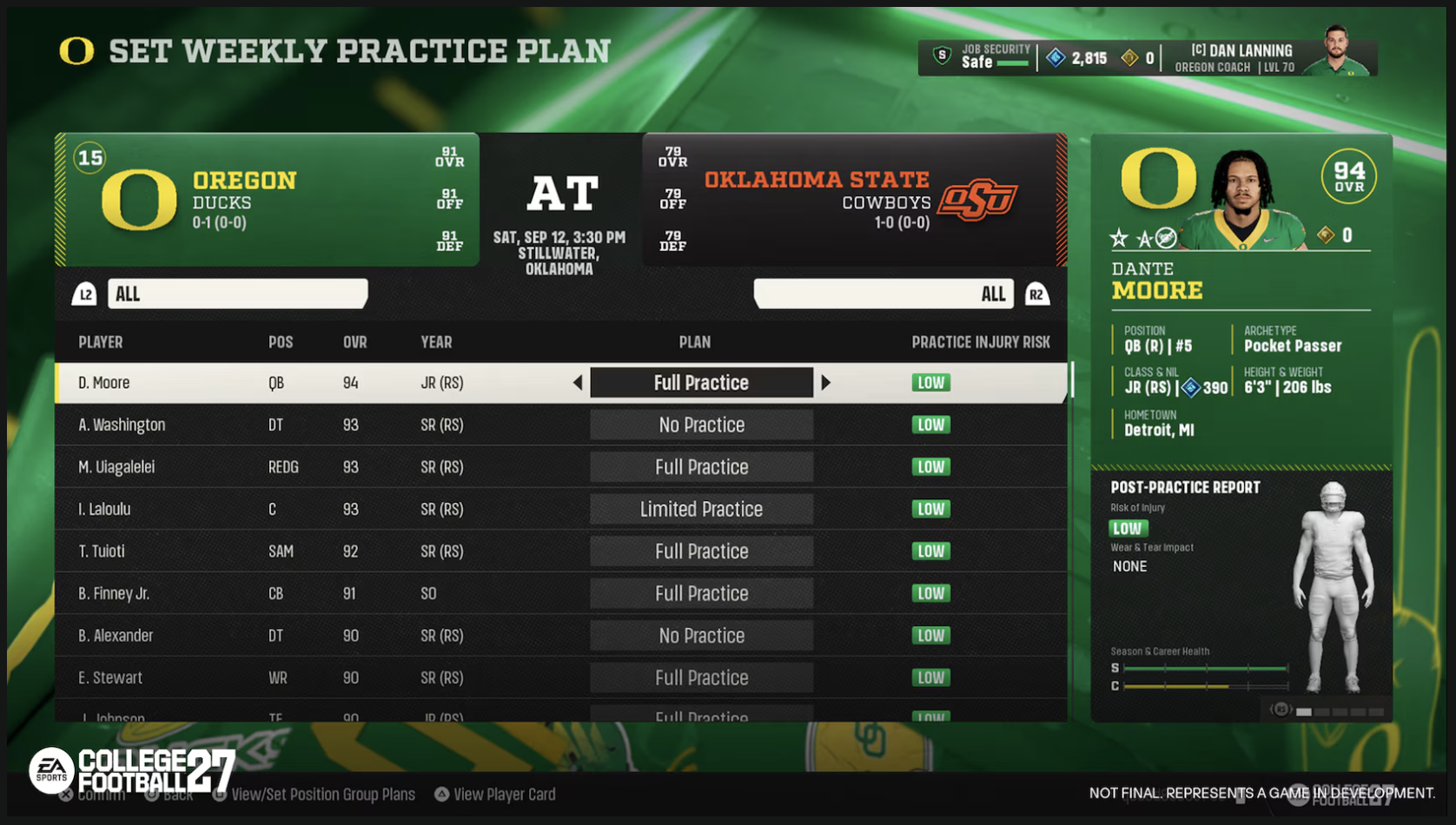 The Weekly Practice Plan screen lets you set Full, Limited, No Practice, or Week Off for every player, with the XP and injury risk for each one laid out next to him. Image: EA Sports.
Then you see the damage. After you commit, the results show what each guy gained in XP and whether he is hot or cold heading into Saturday. It also flags anyone who got dinged in practice. So a heavy week is not free, and you can walk a starter into the game tired or hurt if you run them too hard.
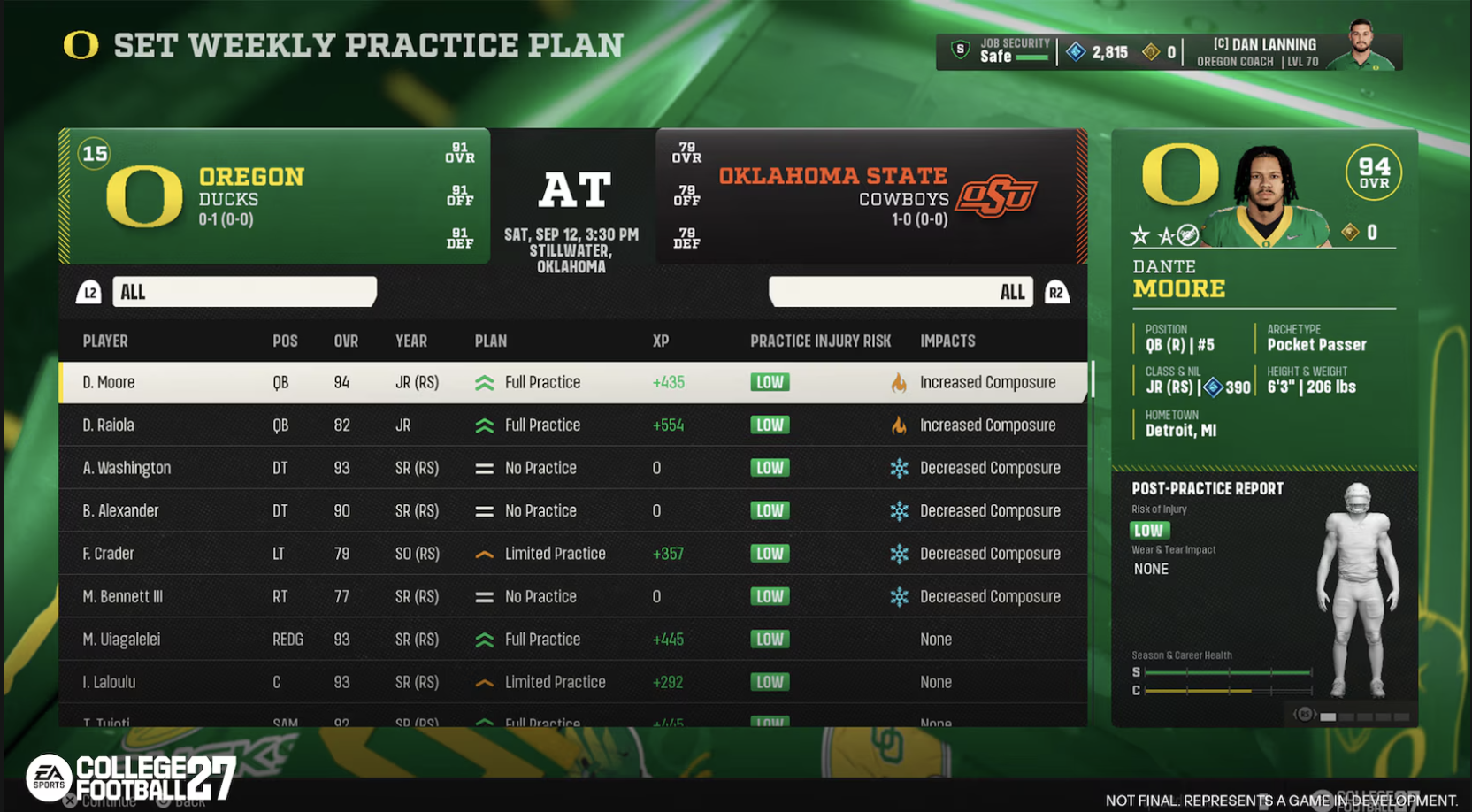 After you commit the plan, the Impacts column shows each player's composure heading into the game. Reps and rest pull in opposite directions. Image: EA Sports.
Practice is your free lab. Here is the part nobody talks about, and the part I actually love. Practice is the low-stakes reps you get while you are waiting on the league to advance, so use them. This is where you sharpen your concepts before they matter on a real Saturday, so go drill the looks that give you trouble, whether that is beating Cover 2 or Cover 3, until the reads are automatic.
It is also the best place to settle a QB controversy. When two guys are close on the depth chart, practice is where you feel out whose throwing motion is cleaner and who just plays better in your offense before you hand him the keys. Pay attention to who can move, too, because a quarterback who can run makes the whole thing easier to call. Trust the reps over the depth chart number on that one.
Progression got rewritten. Two changes matter. First, you cannot bank skill points across seasons anymore. Even on manual progression, any unspent points get auto-applied at training results, so the old trick of sitting on points for a few years to spike a guy to a 95 is dead. Second, the cost to upgrade changed. Physical traits like throw power and quickness run about twice the XP they did last year, while the technical stuff like accuracy stayed cheap.
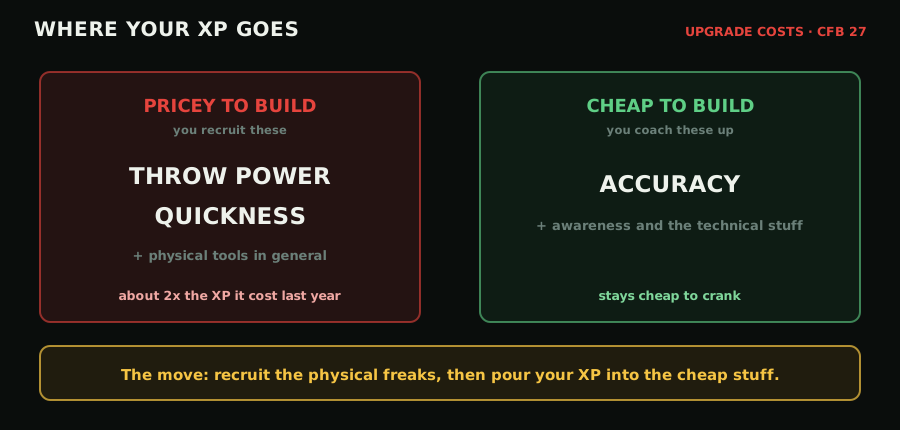
So recruit the freaks. That cost change quietly tells you how to build a roster. Speed and arm talent are hard to coach up now, so you want guys who walk in with the physical tools already there. The cheap stuff like accuracy you can pour XP into after they arrive. One creator took a raw 69-overall up to a usable 76 just working the cheap attributes, and that math holds at every position.
Roster quality-of-life. A couple of small wins make all of this easier to manage. Dev traits now show right in the roster sheet next to speed and overall, so you are not clicking into every guy to find them. And the player cards screen lays out each player's skill caps, so you can see how high a project can actually climb before you sink XP into him.
Why it matters
Development is how you out-build the blue bloods. You will not win the budget war straight up, so winning it on player growth is the lever you actually control, through a smart practice plan and smarter XP spending.
The skill-point change kills a crutch. There is no more hoarding points to manufacture a 95 overall out of thin air. You develop guys in real time now, which makes your facilities grade and your weekly plan matter even more.
And the upgrade-cost change rewards scouting. The guys worth signing are the ones with tools you cannot teach, so you find the raw athlete and build the cheap stuff yourself. That is the value play, same as it ever was on the recruiting trail.
What to watch this year
Year one is everybody mapping the new development math. The threads worth tracking:
- The exact upgrade multipliers. Throw power and quickness landed around 2x, but the full cost table across every attribute is still getting mapped. Once the community nails down which traits are cheapest per point, the optimal build will sharpen up fast.
- Practice XP versus injury risk. Nobody has the exact injury math yet on full-go weeks. Until we do, ride Limited for your stars in body-blow weeks and save Full Practice for the guys who need the reps.
- Does auto-practice leave XP on the table? The one-button plan is convenient, but the auto logic may not max your development. Worth testing whether hand-setting your plan beats the button over a full season.
- Position changes. Early word is they play about the same as last year, but if the new XP costs make a converted edge or safety cheaper to build than recruiting one, that is a value angle worth watching.
Where to start tonight
Set your practice plan around health first, then XP. Ride your banged-up starters at Limited and give a beat-up position group the week off when the schedule lets you. Save Full Practice for the young guys who actually need the reps.
Then go play a practice or two while you are waiting on the league to advance. Rep the coverage that keeps beating you and let both your quarterbacks throw, because the guy who looks right in practice is usually the guy you run with.