Two-Sided NIL in College Football 27 (How to Land Players and Keep Them)
NIL in College Football 27 is really two budgets fighting over one wallet.
Recruiting NIL lands new players. Roster NIL keeps the ones you already have. Both pull from your Dynasty Points, so every point you throw at a five-star on the trail is a point you will not have when your breakout corner asks for a raise in December. That tension is the entire feature.
Here is the takeaway before the details: your budget is tight, so spend it with a purpose. Put your points on the guys who move your program and the ones you cannot replace. Then let some good players walk, because you will have to, and every overpay you make now is a bigger bill next season.
This is the engine inside our full What's New rundown for CFB 27 Dynasty that touches every roster decision you make, and it spends the same points as the Dynasty Blueprint, so it earns its own breakdown.
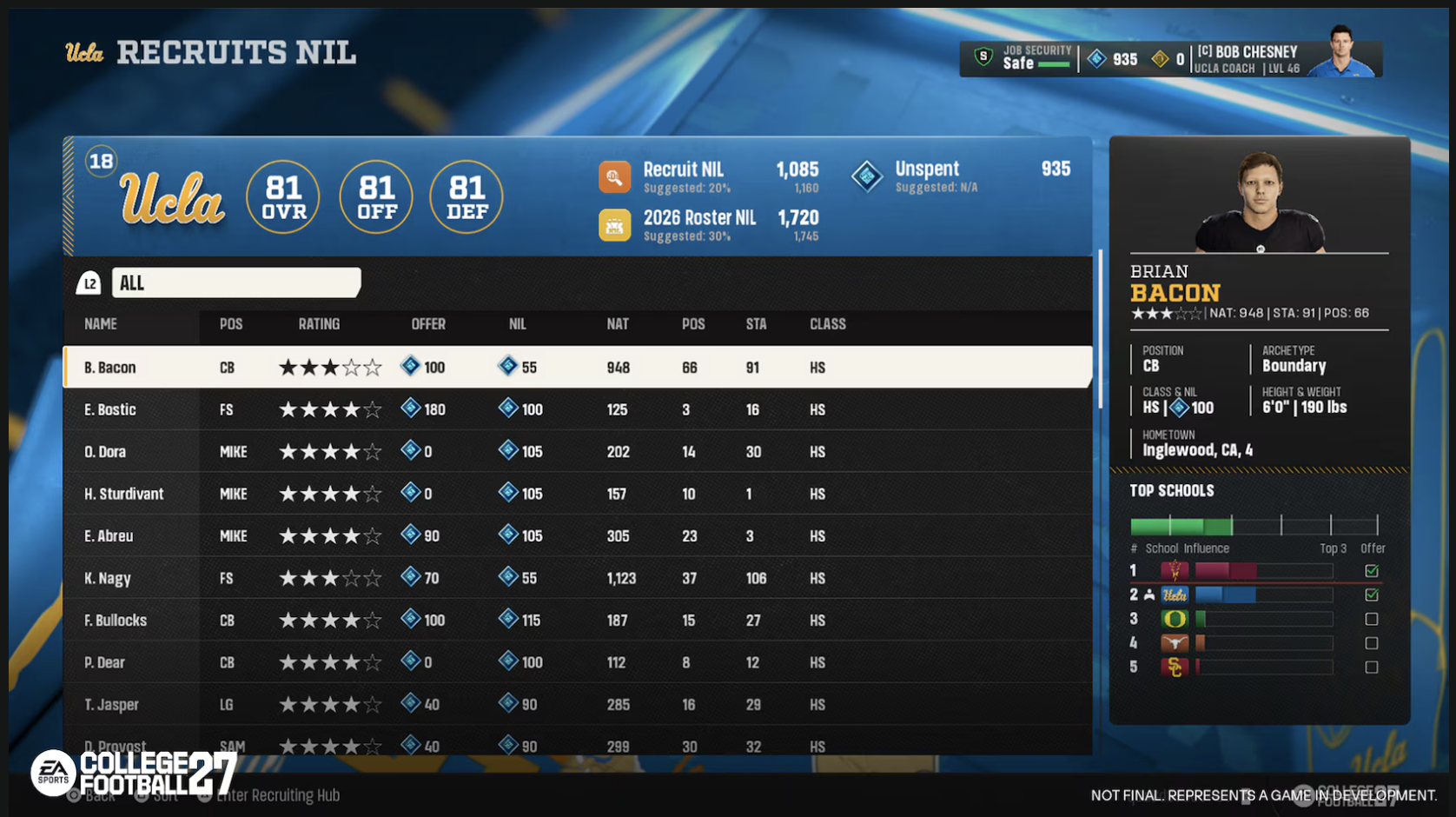 The Recruits NIL spreadsheet lines up what you offered against what each kid expected, so you can see at a glance where you are overpaying. Image: EA Sports.
What it is
Two sides, one wallet. Recruiting NIL is for landing high schoolers and transfers. Roster NIL is for keeping the players already in your building. They are separate jobs draining the same pool of Dynasty Points, right alongside staff and facilities.
Expected NIL, and it is personal. Every recruit and every guy on your roster carries an expected NIL number, and it is relative to your school. The same kid wants one number from Alabama and a different number from Kent State. For recruits it keys off star rating, position, his dealbreaker, and your Team Prestige. Five-stars and premium spots cost more, and here is the part that trips people up: a lower-prestige school pays more, not less. A blue blood signs a kid who already wants to be there. A nobody has to wave more money just to get taken seriously.
One creator with the game early pulled the same recruit up at 140 points for one program and almost 400 for another. Same player. Your prestige set the price, and the smaller school was the one staring at the big number.
Roster numbers climb on their own. For players already on your team, expected NIL runs off overall, class year, position, awards, his dealbreaker, your prestige, and what you have paid him before. Anyone with a Brand Exposure dealbreaker cares about NIL more than most. And these numbers do not sit still. A guy who takes a leap or puts up a big season wants more the next year. So does everybody if your prestige slips or you stop meeting their dealbreaker.
Recruiting NIL: the offer is a real decision now. You cannot hand out scholarships in the preseason anymore. Preseason is scouting only, and offers start in Week 0. Since every offer carries NIL, you are not papering your whole board with offers like the old days. Each one spends real points.
When you make the offer you see the kid's expected number sitting right next to what you are putting down. Beat it and his interest climbs and you bank a weekly influence bump. Come in under it and interest drops and you eat a weekly penalty. Lowball him badly enough and he pulls you off his board for good. One creator put 60 on a three-star who expected 80, and the kid dropped him on the spot. You can push all the way to twice his expected number for the biggest bump.
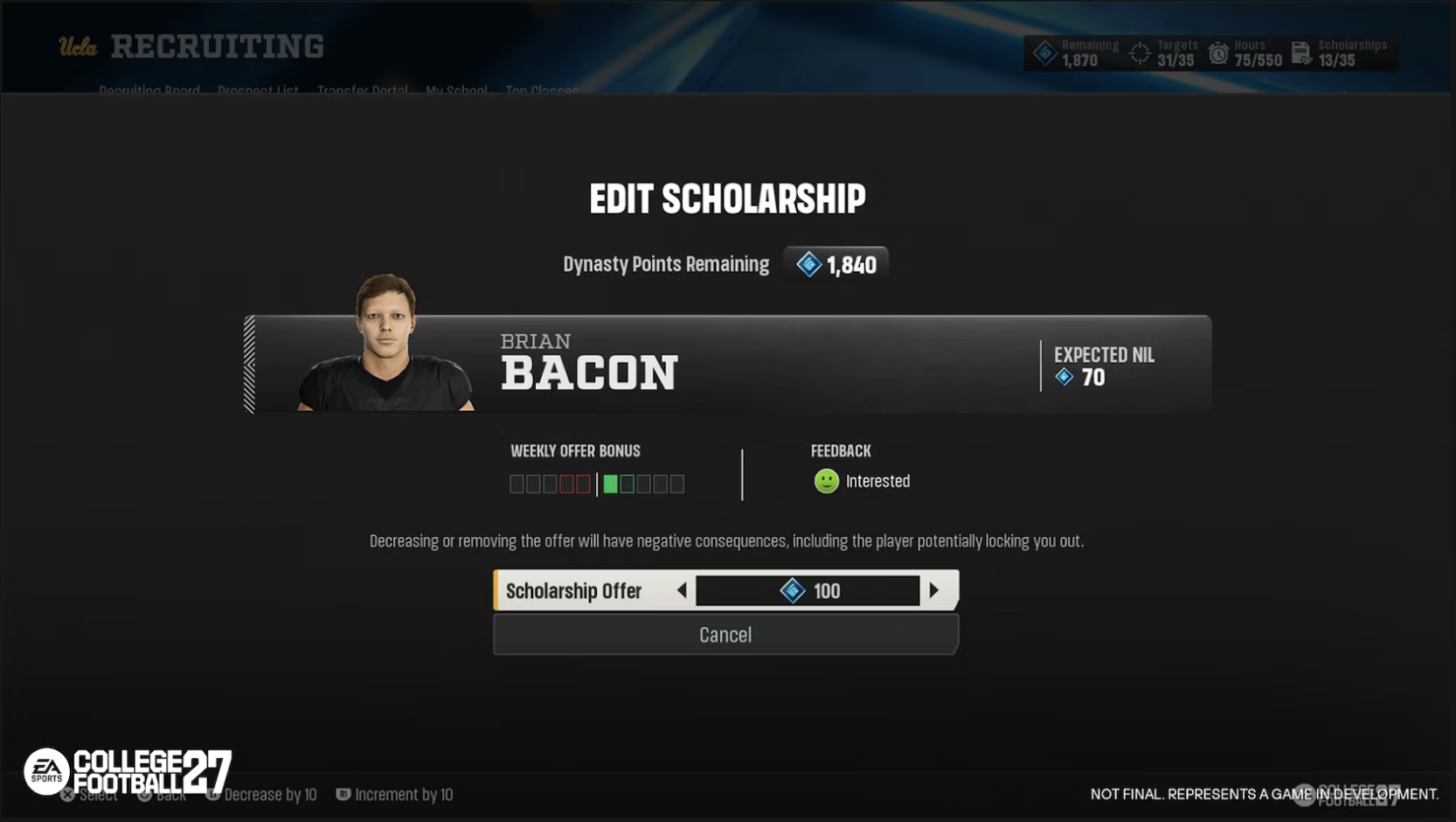 Offer over the expected number and the kid reads "Interested." Drop below it and the same screen flips to "Very Disinterested." Image: EA Sports.
The floor trap. This is the one that bites. The second you go above a kid's expected number, that higher number becomes his new floor. Try to walk it back later and you take a negative influence hit, and if you yank it too far he can lock you out of his recruitment entirely. That floor does not disappear when he signs. It follows him onto your roster and grows every time he earns a bigger role or wins something. So the early overpay you used to win one recruiting battle turns into a tax you pay every offseason he is on the team.
Worth knowing: just meeting the expected number is not a winning move. The guys who have played it early describe the expected figure as a baseline that gets you basically nothing, one green bar at most. If you want NIL to actually swing a battle, you have to clear the number, not match it.
The float saves your budget. Here is the mechanic that makes aggressive bidding survivable. The NIL on an offer comes out of your points the moment you offer, but you get all of it back if the kid signs somewhere else or you drop him from your board. So you can have offers out on a whole slate of targets and only truly pay for the ones you land. The only ceiling is having enough points on hand to cover every open offer at once.
Transfers cost more. The portal leans even harder on NIL. The window is short and the kid's motivations are already out in the open, so there is less courting and more paying. The house recruiting rule does not change here: sign high school kids who play early, then hammer the portal for everything else. The new wrinkle is the portal has a price tag now, so the value play is finding that high-ranked guy before his number catches up to his tape. The rest of the new trail, the funnel and the flips, is its own breakdown: how recruiting works in CFB 27.
Tracking it. Three screens keep you honest. The Recruiting Board shows NIL offered per prospect, and the Recruits NIL spreadsheet lines up expected versus offered across your whole board. The Top Classes screen zooms out to total NIL spent by every school in the country.
Roster NIL: keeping your guys. Retention happens at End of Season Recap, where the game hands you an action item to set each player's NIL for next season. The screen defaults to his expected number. Bump it and he is more likely to stay. Cut it and he is more likely to walk. Whatever you set is a commitment for the full year.
A Risk of Leaving column flags who is most likely to bolt, either for a bigger bag somewhere else or, for your best players, a jump to the NFL Draft. Raising a guy's number lowers his risk, and a strong enough offer can talk a draft-eligible star into running it back in college for another year.
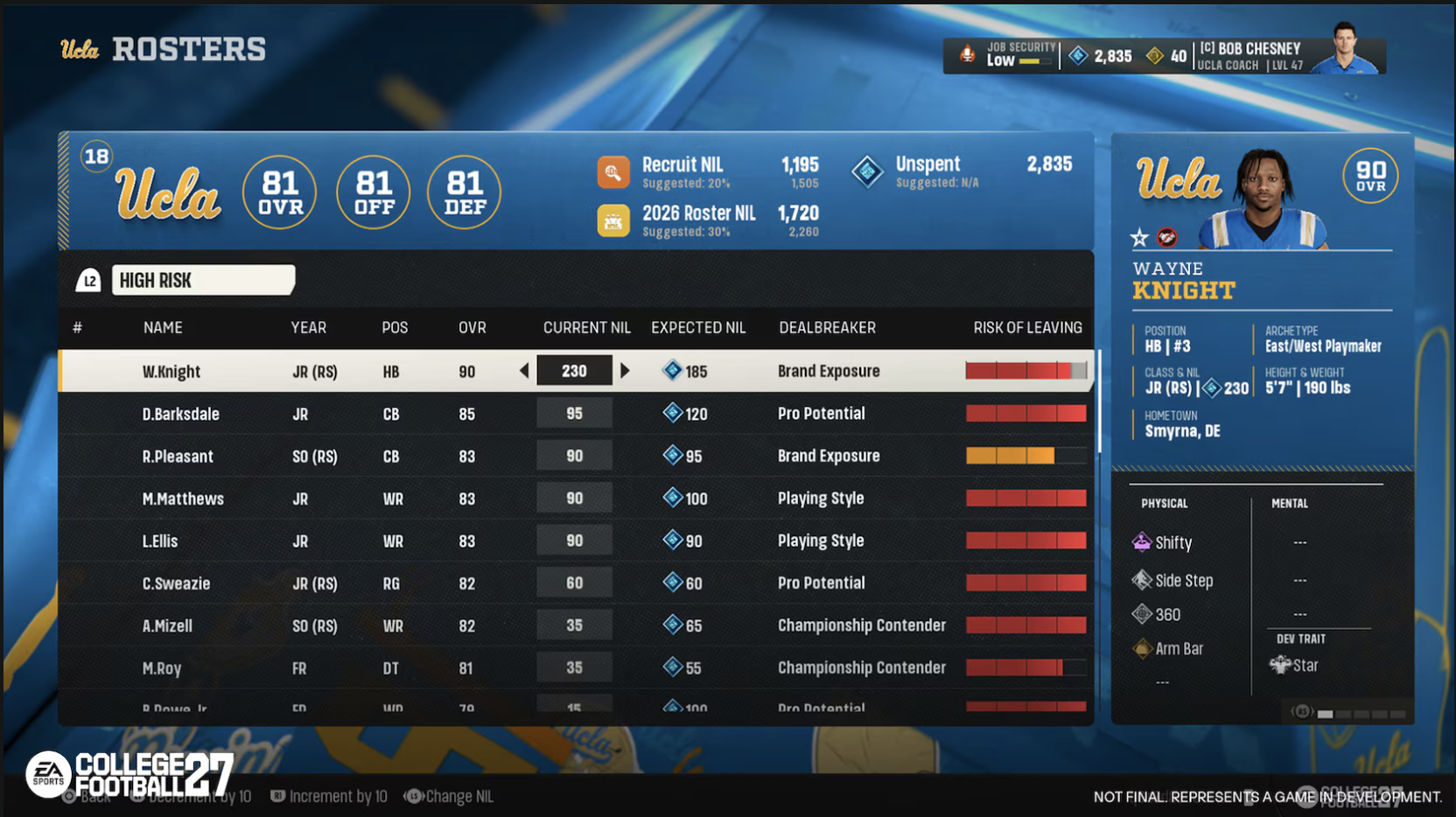 The High Risk filter pulls every player who might walk into one list, with current NIL next to what they now expect. Image: EA Sports.
You cannot keep everyone. When a young QB, your pass rusher, and a breakout receiver all want a raise in the same offseason, you are picking who is worth protecting and letting the rest go. After you advance the week you get one last persuasion attempt on the guys leaving, but it cannot erase a number you already set. If you slashed somebody's NIL to save points, that is part of why he is walking, and the game remembers.
The retention math gets ugly fast. Guys with early hands-on describe a young quarterback you signed for around 20 points wanting something like 120 to stay after a breakout year. That is the floor trap again, just on the back end.
For tracking, the retention spreadsheet defaults to your at-risk players and filters by position group, and the Team Stats screen shows NIL spend by position group for every program, so you can see exactly where the blue bloods are loading up.
Why it matters
NIL is where the resource gap between programs turns into wins and losses.
The throughline EA built the whole system around is spending with purpose, full stop. Every point you sink into a recruit is a point you do not have for retention, and every overpay raises a future bill. One creator even signed the 68th-ranked class while outspending teams that finished above him. Where the points land matters more than how many you throw. Get loose with it and you wake up two seasons later unable to keep your own roster together.
The gap compounds, too. A money-rich program stacks more Dynasty Points, which means deeper NIL, which means it lands the kid you wanted while keeping its own stars. You are the one stuck choosing between the two. One creator watched Ohio State drop close to 4,000 points just acquiring players in a single season, before a dime went to facilities, staff, or its own roster. At the other end, one five-star can eat a bottom-tier school's entire 500-point budget, and a creator who sent the house on one still got locked out. That is the arms race you are walking into.
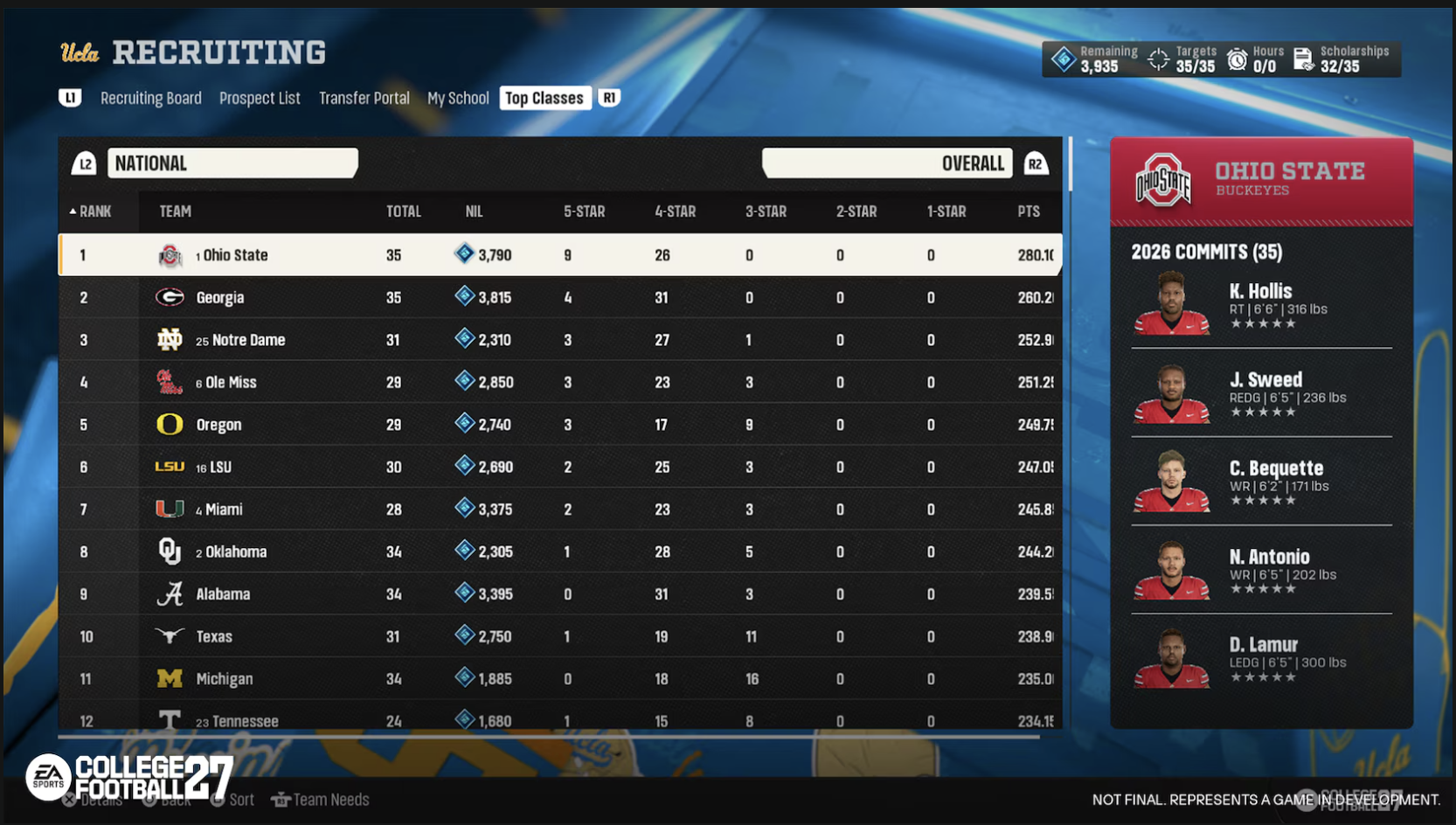 Top Classes now lists total NIL spend next to the class rankings, so you can see exactly who is buying their way up the board. Image: EA Sports.
The flip side is that NIL hands a smart smaller program a real lever for the first time. You will not outspend Georgia. But you can pick the two or three guys who actually move your season, clear their number to win those battles, and let the position-group spend screens tell you where the big dogs are not paying attention.
What to watch this year
Year one is everybody figuring it out at once. The threads worth tracking:
- The rug-pull. The community is already poking at whether you can commit a kid on a big offer, then pull the NIL back at the last second once your rivals stop spending hours on him. The early read is that dropping too far below your original number, somewhere around ten percent, locks you out or triggers a decommit. Whether there is a safe amount you can claw back without torching the recruitment will get solved in the first couple weeks.
- Rentals over retention. With some three-stars wanting 70 to 100 points and your budget always tight, holding everybody is off the table. Expect a lot more roster flipping and a lot of guys treated as one or two year rentals. The question is which positions are worth a real long-term number and which you just keep cycling.
- The Rainmaker paywall. The new coach archetype built around all of this, Rainmaker, sits behind the MVP+ membership, one of the two paywalled trees we break down in Coach and Career. Dealmaker turns NIL offers into extra recruiting influence and Stay Power makes every retention dollar stretch further. Two more abilities, Budget Booster and Contract Incentives, funnel points back into your budget from your grades and your AD goals. It is strong, and locking it behind a separate purchase is the loudest complaint about the deep dive. In an online league you can toggle it off so nobody has it.
- Online leagues and the floor. In a 32-team human league there is always one guy who dumps his whole budget on a single recruit. Watch how your commissioner handles that, and watch the floor trap bite people who overpaid in year one and cannot climb out from under it by year three.
Where to start tonight
Before you start blasting offers, open your board and your roster in the same sitting and decide which side of NIL is your priority this year. If you are rebuilding, your points go to a small handful of recruits you actually clear the number on, not a wide board you only meet the number on. If you are a win-now team, protect the three or four guys you cannot replace and let the depth walk.
And whatever you do, do not throw a giant number at a kid in a recruiting battle you were already winning. That floor follows him for four years.