The Biggest Changes to Defense in College Football 27 (and How to Use Them)
Defense got the biggest glow-up in this game in years. EA is straight up calling it the biggest coverage overhaul in the history of EA Sports football. Before you go selling out everything you know, take a breath, because we have heard some version of that pitch before.
We already broke down the biggest changes to offense, and the full dynasty overhaul lives in our What's New rundown. This is the other side of the ball. Quick note: this is all from pre-launch hands-on, so a button or a number here and there can still move before the July 9 release.
Here are the defense changes worth knowing, ranked by how much they matter for your next game:
- The coverage overhaul (zones that finally look for work)
- Plaster logic (the scramble answer)
- The pre-play control rebuild (everything on the left trigger)
- Custom adjustments (two-button answers on defense)
- Coverage checks for modern spread sets
- Gap integrity and defensive aggression (dialing the run fits)
- 31 playbooks and 16 new fronts
One thing up front. Defense looks overpowered at the start of every cycle. The CPU stuffs you, routes get jumped, and everyone says the AI finally figured it out. Then a few weeks in, the community finds the soft spots and the meta settles. So read all of this as real and promising, with the asterisk that the season will be the judge. More on that at the bottom.
1. The coverage overhaul: zones that look for work
This is the big one. For years your zone defenders would sit in their little area like cones while a route ran right past them. This year they look for work. A hook defender sees a route coming into his zone, shuffles, and undercuts it. He carries threats through his area and passes them off. He plays like he can see.
You also get to set the temperament. Inside your coaching adjustments, each coverage can run aggressive or conservative, with an ultra setting at each end for when you want to crank it. Aggressive clamps the short stuff like drags, whips, returns, and flats, with the tradeoff that you are softer over the top. Conservative bails your guys deeper to wall off the explosives and makes the offense earn it underneath. You can still shade under and over the top on top of that.
The how: click the right stick in for coaching adjustments, or set it once in the main menu so it carries every game. Drop into coverage strategy and pick your zone behavior.
Knowing what your coverage actually gives up matters more than ever now. Our chalk talk on beating Cover 3 and beating Cover 2 doubles as a map of the soft spots you are now better equipped to defend.
The honest read: this is the change that makes or breaks the year, and it is also the one most likely to get overstated. Better zone logic feels incredible in week one. Whether it holds up once people learn which routes still split it is the open question.
2. Plaster logic: the scramble answer
If you have ever lost your mind watching a guy scramble around for nine seconds while your whole secondary covers air, plaster is for you. When the play breaks down, your defenders attach to the nearest receiver once the QB takes off.
You control it in coaching adjustments. Off leaves everyone in their zones. Conservative has your backside zone guys peel off and lock onto the nearest man when the play extends. Aggressive turns everybody loose into man once it triggers, which gives you max coverage on the scramble at the cost of your underneath help. You also set the trigger, when he leaves the pocket or a timer, and how fast it fires.
The how: match your plaster to who you are playing. A guy who breaks contain every snap, crank it aggressive. A pocket passer, leave it lighter so you keep your zone help.
The honest read: this is a real answer to the oldest cheese in the book, and you will still see it whiff. Defenders will occasionally stand around when they should lock on. Better than last year by a mile, and a long way from a force field.
3. The pre-play control rebuild
EA tore up the pre-play controls and rebuilt them, and this might be the single biggest gameplay addition on either side of the ball. Last year your adjustments were scattered across the d-pad and sticks in ways that made no sense in a hurry. Now it is organized.
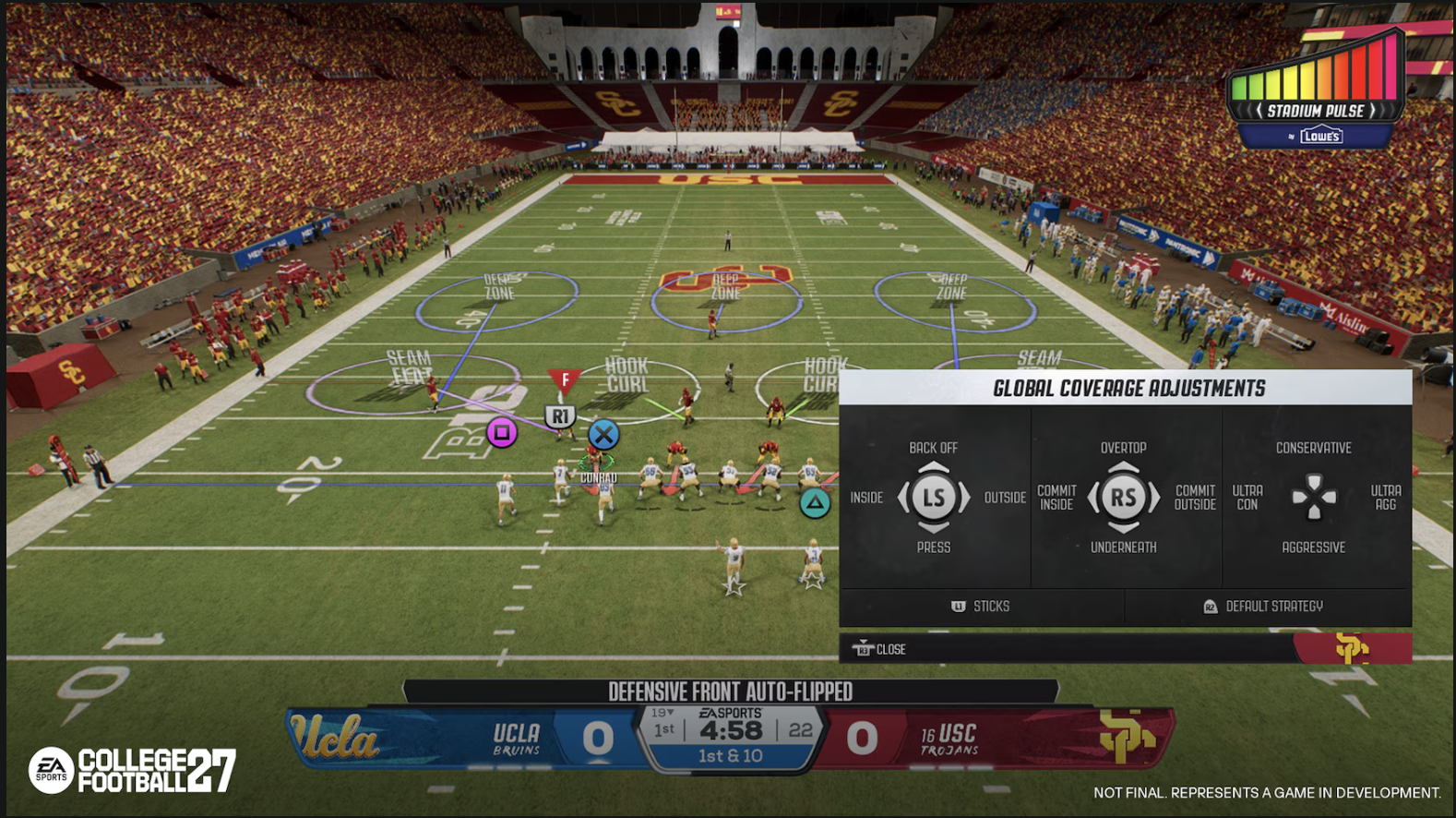
Holding Left Trigger brings up the global coverage hub, with press, leverage, and Smart Zone behavior all one input away. Image: EA Sports
Hold the left trigger and you get a global coverage hub. From that one place you press or back off, play inside or outside leverage, pass commit, set your Smart Zone strategy, and focus your deep zones. Tap to bring up a single receiver and you can press him, back off, shade his leverage, double him, or bracket him. Holding left trigger, picking the receiver, and tapping Square or X brackets him that fast.
The how: live on the left trigger. What used to be 15 to 20 button presses is a couple of clicks now. There is a real learning curve here, so spend a session in practice retraining your thumbs before you take it online.
The honest read: this one is durable. Faster, cleaner control is a tool, and tools do not get patched away when the community finds a cheese. Bank it as a real win.
4. Custom adjustments: two-button answers on defense
Here is the one that helps everybody, sweat or casual. Defense now has custom adjustment macros. There are stock ones built in, and you can save up to 10 of your own.
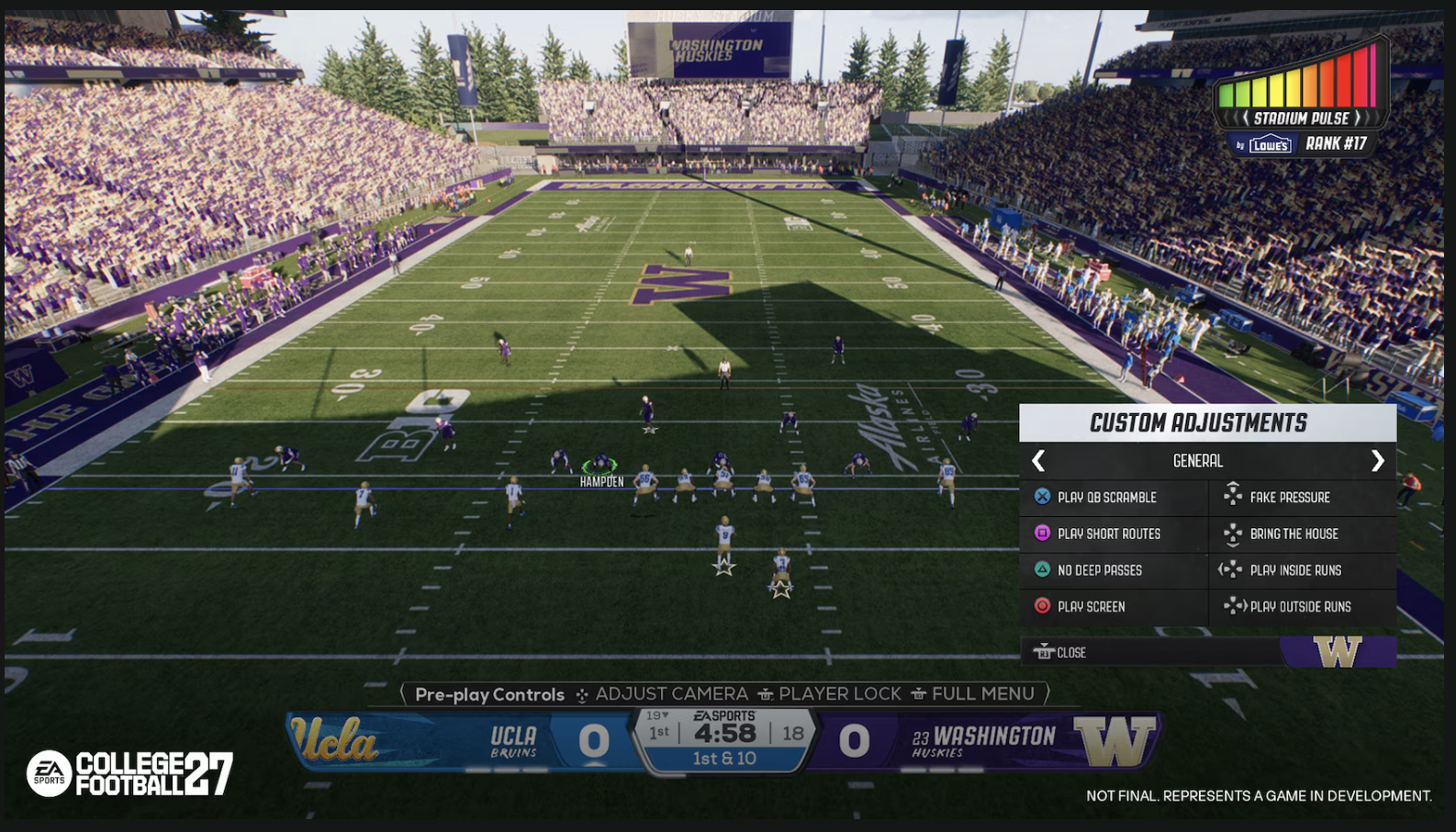
Stock defensive macros let you call a full situational scheme like Bring the House or No Deep Passes the moment you read the formation. Image: EA Sports
The stock macros are the quick win. Read a scrambler and you tap Play QB Scramble, which spreads your line and drops a spy with contain in one press. Bring the House, No Deep Passes, Play Short Routes, Play Inside Runs, they are all sitting there ready. Two buttons and your defense is set for the situation.
The bigger deal for grinders is building your own. You can bake a full setup into a macro, fronts and coverage and leverage and per-player assignments, then call it from the play screen. The old complaint was always I cannot set my defense up fast enough before they snap. That complaint is dead.
The how: tap left bumper in game for the stock macros. To build your own, go to create and share, then custom adjustments, and set up to 10 per side.
The honest read: like the pre-play hub, this is durable. It raises the ceiling for good players and lifts the floor for everyone else, and no amount of meta-chasing takes it away.
5. Coverage checks for modern spread sets
Modern offenses live in stacks, bunches, trips, and isolated looks to create natural rubs and free releases. This year the defense has built-in checks to handle them. In your coaching adjustments you can set how your Cover 3 Match, Quarters, Palms, and Cover 6 react to those looks, so your guys pass off routes and exchange responsibilities the way coverage is supposed to work.
Man coverage got answers too. Your defenders can stay locked through a bunch and switch correctly with cross man. And you can double or bracket the one guy you cannot let beat you.
The how: this is deep-end stuff. If you nerd out on coverage rules, dig into the match checks and tune them per formation, and our guide to running coverage on defense breaks every one of them down in plain terms. If you do not, the stock playbooks already ship with sane defaults, so do not sweat it.
The honest read: powerful and genuinely hard to evaluate this early. The people who master it will be a problem. Most of us will need a few weeks to even understand it.
6. Run fits you can dial: gap integrity and defensive aggression
Strip away the scheme and defense comes down to one question: can you stop the run? Answer it and you set the terms for everything else. So the two new run-defense knobs matter more than their billing.
Gap integrity decides how strictly your guys play their assigned fit. Conservative keeps them home in their gap, which is what you want when you are worried about a cutback. Aggressive lets them shed and chase a play, which makes splash stops and also opens lanes if you guess wrong.
Defensive aggression sets the tempo. Conservative linebackers slow-play the run and stay back for play action. Aggressive ones fly downhill, make bigger stops, bite harder on play action, and tire faster.
The how: both live in general coaching adjustments. Stay conservative by default, especially against a good run team or a play-action heavy buddy. Flip aggressive when you have a lead and you want to force them one-dimensional.
The honest read: this is real control and a smart addition. Just remember aggressive is a double-edged sword, and the CPU will make you pay for guessing.
7. 31 playbooks, new fronts, real identity
Defense went from 9 playbooks to 31. Every one of the 138 teams maps to a defensive style now, from Man Pressure to Shell to Zone Pressure to Multiple, so a team actually feels like itself when you load its book. They added 16 new formations on top, with looks like 3-3-5 3 High Over, 3-4 Grizzly, Nickel Double Mug, and Single Mug Dime.
The how: go find the book that matches how you want to play. If you live in nickel and want exotic pressures, the new mug looks are for you. If you want to sit back and play coverage, grab a shell book.
The honest read: more options and more team identity. Hard to argue with that. This is the kind of addition that just makes the game better with no real downside.
A few smaller ones worth knowing
- Press and leverage actually matter now. Put a corner in inside leverage and he is better positioned on inside breaks, outside leverage for outside breaks. Jostle gives your high-coverage, low-speed corners real value again. Ratings still rule, but football IQ shows up too.
- The tackle stick. Every direction on the right stick is a tackle now: up for hit stick, down for cut, left for lunge, right for wrap. You never have to come off the stick to bring a guy down.
- Contains show in the play art. Before you even call it, you can see which plays bring a contain, so there is no surprise when your end loops out.
- Red zone zones got smarter. Deep defenders stop parking on the back line and actually defend the sideline down tight.
- The CPU has all your toys. Aggressive coverages and disguised shells, the AI runs them too, which is big for offline dynasty guys.
Why we are pumping the brakes
Here is the part nobody selling you the game will lead with. Defense gets overstated every single year.
It happens like clockwork. A new game drops, the CPU is suddenly stingy, your usual routes get jumped, and everyone declares the AI fixed at last. Then three or four weeks in, the grinders find the holes, a few money concepts shake out, and the same people are back to hanging 40. The early word on this game already has the CPU stuffing drives it never used to, which is exactly the pattern.
There is also the honest stuff straight from the early hands-on. Plaster still misses. Zones still stand around now and then. The build people played was not even final. That is just the honest picture before launch.
So here is how we are sorting it. The pre-play control rebuild and the custom adjustment macros are durable. They are tools, and tools survive the meta no matter how it shakes out. The coverage overhaul and the smarter AI are the headliners and the wild cards. They look amazing right now. Ask us again in October.
What to do tonight
Do not start by memorizing the match-coverage checks. Start with the easy money. Set your coverage behavior and your plaster in the main menu so they carry every game, then build two custom macros: one to stop the run, one to stop a scrambler. That is most of the benefit for twenty minutes of setup.
Then go play and find out for yourself whether the defense is really back, or whether it just feels that way for a week.